Category
Difficulty
Showing 150 symbols.

Standard 125V 15A or 20A two-outlet receptacle for general-purpose branch circuits.

Ground-fault circuit interrupter receptacle required in wet or damp locations to protect against ground faults.

Arc-fault circuit interrupter receptacle that detects dangerous arcing and de-energizes the circuit.

Receptacle with weather-resistant rating (WR) for outdoor or wet locations under in-use covers.

Receptacle with insulated grounding terminal for sensitive electronic equipment to reduce noise.
High-voltage receptacle (NEMA 6-15/6-20/14-30/14-50) for appliances like dryers and ranges.
Receptacle mounted flush in the floor with a cover plate for room interiors.

Duplex receptacle with tab broken so each outlet is on a different circuit or controlled separately.

Standard wall switch that controls a load from one location with two positions: on and off.

Switch used in pairs to control a single load from two different locations.

Switch used between two 3-way switches to control a load from three or more locations.

Variable switch that controls light intensity by adjusting voltage or chopping the AC waveform.

Switch requiring a key to operate, used for security or restricted-access applications.

Switch with built-in motion detector that automatically controls lighting based on occupancy.

Spring-loaded switch that only makes contact while pressed; releases to off position.

Lighting outlet on the ceiling for pendant or surface-mounted luminaires.

Wall-mounted lighting outlet typically for sconces or wall-pack luminaires.

Lighting fixture installed flush within a ceiling cavity; can-style or LED downlight.

Continuous lighting track that allows movable heads along its length.

Battery-backup lighting fixture that activates upon loss of normal power.

Illuminated egress sign required at exits for life safety compliance.

Enclosure where conductors are joined, spliced, or pulled; must remain accessible.

Cabinet containing buses and overcurrent devices for branch-circuit distribution.

Switch used to disconnect equipment from its power source for service or safety.

Enclosure with jaws that holds the utility revenue meter at the service entrance.

Point where utility conductors transition to premises wiring at the service equipment.
Secondary panelboard fed from the main service for distributing branch circuits in a remote area.

Hardwired smoke alarm device required in dwelling units for life safety.

Hardwired CO alarm required in dwellings with fuel-fired appliances or attached garages.

Class 2 low-voltage signaling device for door annunciation.

Temperature-control device wired at line voltage for baseboard heat or unit heaters.

Threaded bushing used to bond metallic raceways to the grounding system.

Enclosure used to facilitate pulling conductors through a long or bent raceway run.

Sheet-metal trough with hinged or removable cover for housing conductors.

Fitting (LB, LL, LR, T, C) providing access for pulling and splicing in a raceway run.
Surface-mounted enclosed channel system (Wiremold style) for routing conductors.

Open support system for cables and conductors in industrial and commercial installations.

Prefabricated assembly of conductors in an enclosed metal housing for power distribution.

On-site engine-driven generator providing standby power during outages.

Switch that transfers loads between the utility source and an alternate power source.
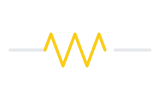
Two-terminal passive component that opposes current flow with a fixed resistance value in ohms.
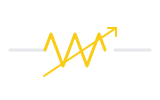
Resistor with adjustable resistance value; includes potentiometers and rheostats.
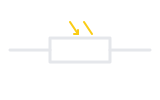
Light-dependent resistor (LDR) whose resistance decreases with increasing light intensity.
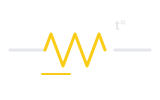
Temperature-dependent resistor used for temperature sensing or inrush limiting.
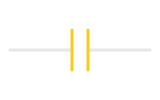
Two-terminal passive component that stores energy in an electric field; no polarity required.
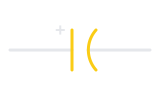
Electrolytic capacitor with positive and negative terminals; reversing polarity damages it.

Capacitor with adjustable capacitance, used in tuning circuits.

Coil that stores energy in a magnetic field and opposes changes in current.

Inductor with a ferromagnetic core to increase inductance.

Two-winding transformer that steps voltage up or down on a single-phase system.
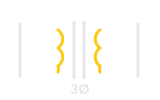
Three-winding transformer for three-phase power distribution in delta or wye configurations.

Transformer with a single tapped winding shared between primary and secondary.

Instrument transformer that steps high current down to a measurable level for metering or relaying.
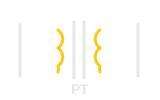
Instrument transformer that steps high voltage down to a measurable level.
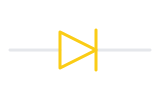
Semiconductor device that allows current flow in one direction only (anode to cathode).
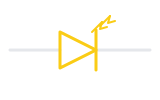
Diode that emits light when forward-biased; used in indicators and lighting.
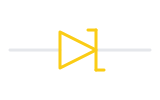
Diode designed to operate in reverse breakdown for voltage regulation.
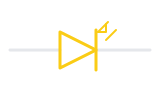
Diode that generates current when exposed to light; used in optical sensors.

Bipolar junction transistor with N-P-N structure; arrow points outward on emitter.

Bipolar junction transistor with P-N-P structure; arrow points inward on emitter.

Field-effect transistor with N-type channel controlled by gate voltage.

Field-effect transistor with P-type channel controlled by gate voltage.
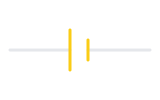
DC power source represented by one long line (positive) and one short line (negative).
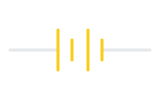
DC power source with multiple cells in series for higher voltage output.
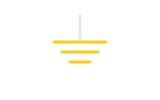
Connection to the earth via grounding electrode; three horizontal lines decreasing in length.

Connection to the equipment chassis; not necessarily earth-referenced.

Common reference for low-level signal circuits; isolated from power ground.

Overcurrent protective device that melts open under fault current.

Resettable overcurrent protective device that opens under overload or fault.
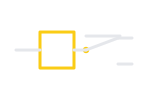
Electromechanical switch with single-pole double-throw contacts controlled by a coil.

Heavy-duty relay designed to switch motor loads or large power circuits.

Triangle-shaped IC symbol with two inputs and one output; high-gain DC amplifier.

Digital logic gate whose output is HIGH only when all inputs are HIGH.

Digital logic gate whose output is HIGH when any input is HIGH.

Inverter gate; output is the logical complement of the input.

Setting that measures direct-current voltage; symbol is V with a solid line over a dashed line.

Setting that measures alternating-current voltage; symbol is V with a sine wave.

Setting that measures direct current in amperes; symbol is A with a solid and dashed line.

Setting that measures alternating current in amperes; symbol is A with a sine wave.

Setting that measures resistance in ohms; symbol is the Greek letter omega.

Setting that emits a tone when resistance is below a low threshold (typically under 50 ohms).

Setting that applies a small forward voltage to verify diode function; reads forward voltage drop.

Setting that measures capacitance in farads (F, microfarads, nanofarads, picofarads).
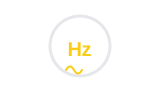
Setting that measures frequency in hertz; typically labeled Hz on the meter.

Setting that uses a thermocouple probe to measure temperature in Fahrenheit or Celsius.

Meter capability that provides accurate readings on non-sinusoidal waveforms.

Meter function that captures minimum and maximum readings during a measurement session.

Meter function that freezes the current reading on the display for recording.

Selector for measurement range; auto-ranging or manual range button.

Meter mode that uses a low input impedance to eliminate ghost voltages.

Current-measuring instrument that clamps around a conductor without breaking the circuit.

High-voltage tester that measures insulation resistance in megohms.
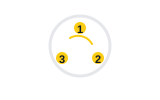
Instrument that determines the rotation sequence (ABC or CBA) of a three-phase system.

Specialized instrument that measures the resistance of a grounding electrode system.

Motor that operates on single-phase AC power; common in residential and light commercial.

Motor that operates on three-phase AC power; standard in industrial applications.

Motor that operates on direct current; common in EVs, traction, and variable-speed applications.

Closed-loop motor with position feedback for precise control.

Motor that rotates in discrete steps; used in positioning and indexing.

Contactor plus overload relay used to start and protect a motor.
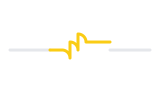
Thermal or electronic device that opens the motor circuit on sustained overcurrent.

Momentary push button that closes the circuit when pressed (e.g., START).

Momentary push button that opens the circuit when pressed (e.g., STOP).

Large red push button typically used for emergency stop (E-Stop).

Push button with built-in indicator light to show status.

Indicator lamp that shows the energization status of a circuit or device.

Rotary switch with two positions such as Hand/Off or On/Off.

Rotary switch with three positions such as Hand/Off/Auto.
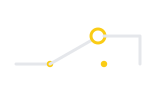
Mechanically actuated switch that detects the position or motion of a component.
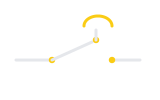
Switch that actuates when pressure crosses a setpoint; used in compressors and pumps.
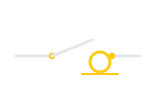
Switch actuated by liquid level; used in sump pumps and tanks.
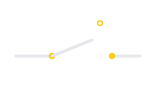
Switch that actuates at a temperature setpoint; used in HVAC and process control.

Non-contact sensor that detects the presence of metal or other materials.

Non-contact sensor that detects objects using a light beam.

Timer that delays energizing the output after the input is applied (TON).

Timer that keeps the output energized for a set time after the input is removed (TOF).

Solid-state device that controls AC motor speed by varying frequency and voltage.

Solid-state device that gradually applies voltage to reduce motor inrush current.

Motor starter that limits starting current using autotransformer, wye-delta, or part-winding methods.

Assembly of motor starters and related controls in one enclosure.

Conductor that connects non-current-carrying metal parts to ground for fault clearing.

Conductor that connects the grounding electrode system to the service equipment.
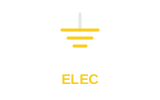
Conductive object that establishes a direct connection to earth (rod, ring, plate, etc.).

Driven rod electrode (typically copper-clad steel) used to establish an earth connection.
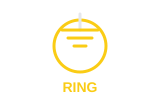
Bare copper conductor ring encircling a building, buried at least 30 inches deep.
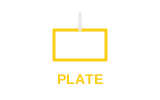
Buried metal plate used as a grounding electrode where rods are impractical.
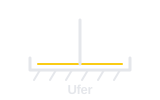
Ufer ground; rebar or copper conductor encased in concrete foundation footing.
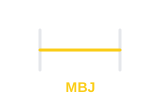
Conductor that bonds the grounded conductor (neutral) to the equipment grounding system at the service.
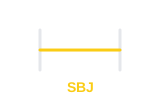
Conductor that bonds the grounded conductor to the EGC at a separately derived system.

Additional ground rod or electrode supplementing the primary grounding system.

Thin-walled steel raceway joined with set-screw or compression fittings.

Threaded steel raceway lighter than RMC but with similar strength.
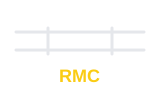
Heavy-wall threaded steel raceway with the most physical protection.

Polyvinyl chloride non-metallic rigid raceway; commonly Schedule 40 or 80.

Spirally wound metal raceway allowing bends and vibration isolation.
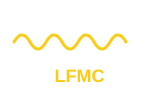
FMC with a liquid-tight outer jacket for wet or oily locations.
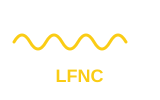
Non-metallic flexible raceway with a liquid-tight outer jacket.
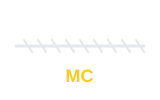
Metal-clad cable with interlocked armor or smooth/corrugated tube.
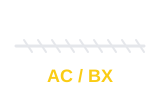
Armored cable with flexible spiral-wound metal sheath; often called BX.
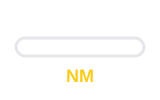
Non-metallic sheathed cable used in dry residential interior wiring.

Underground feeder cable rated for direct burial.
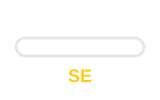
Service-entrance cable used from the meter to the service equipment.

Power and control cable approved for installation in cable tray.
Underground service-entrance cable rated for direct burial below grade.

Initiating device for fire alarm system; ionization or photoelectric sensing.

Fire alarm initiating device that responds to rate-of-rise or fixed temperature.

Manually operated fire alarm initiating device (single or dual action).

Fire alarm device providing audible (horn) and visible (strobe) notification.

PIR or microwave sensor for intrusion detection in security systems.
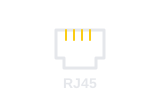
Modular telecommunications outlet for Category 5e/6/6A structured cabling.